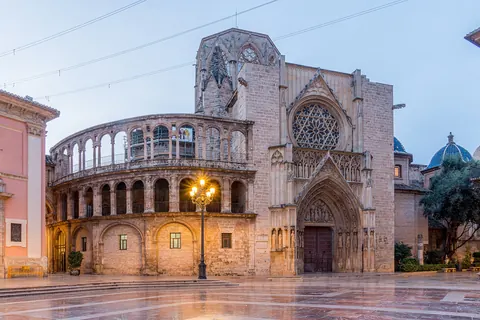
Valencia Cathedral, at greater length the Metropolitan Cathedral–Basilica of the Assumption of Our Lady of Valencia, also known as St Mary’s Cathedral, is a Catholic church in Valencia, Spain.
The cathedral was consecrated in 1238 by the first bishop of Valencia after the Reconquista, Pere d’Albalat, Archbishop of Tarragona, and was dedicated to Saint Mary by order of James I the Conqueror. It was built over the site of the former Visigothic cathedral, which under the Moors had been turned into a mosque. Valencian Gothic is the predominant architectural style of the cathedral, although it also contains Romanesque, French Gothic, Renaissance, Baroque and Neoclassical elements.
The cathedral contains numerous 15th-century paintings, some by local artists, others by the Italian Renaissance artists Francesco Pagano and Paolo da San Leocadio, both commissioned by the Valencian Pope Alexander VI who, when still a cardinal, also made the request to elevate the Valencian See to the rank of metropolitan see, a category granted by Pope Innocent VIII in 1492.
A purported Holy Chalice, believed by many to be the true Holy Grail, is kept in one of the cathedral’s chapels.
Sources
- Wikipédia (fr) : Cathédrale Sainte-Marie de Valence
- Wikipedia (en): Valencia Cathedral
- Wikidata: Q1466926
- Official website
Text: introduction of the Wikipedia article Valencia Cathedral, under the CC BY-SA 4.0 licence (authors: article history). Facts: Wikidata (CC0). Coordinates: Wikidata, map background © OpenStreetMap contributors.